

What is a mini ROV?
Underwater ROVs (Remotely Operated Vehicles) are drones that allow users to see and operate beneath the surface in real time. A mini ROV - also known as a small ROV - is a compact system designed for inspection, documentation, research, and intervention tasks. Unlike autonomous underwater vehicles (AUVs), a tethered mini ROV provides live video feed, real-time control, and immediate decision-making during operations.
Compared to traditional large industrial ROV systems, a small ROV:
- Requires fewer personnel
- Is faster to mobilize
- Is easier to transport
- Has lower operational costs
- Can be deployed in minutes
ROVs have been in the market for decades, but mini ROV technology is still new to many industries. One of our aims has been to make this technology more accessible and demonstrate its advantages across industries.
If you are looking for a tethered mini ROV, lightweight ROV or professional mini ROV for inspections, the Blueye X3 small ROV offers a balance of portability, stability, and professional performance.

What is a mini ROV typically used for?
A professional mini ROV is used across multiple industries and mission types. Typical use cases include:
- Aquaculture: Net pen inspections, mortality removal, mooring line checks, fish health observations
- Maritime & Shipping: Hull inspections, propeller and rudder checks, sea chest inspections, pre- and post-docking surveys
- Offshore & Energy: Platform structure inspections, subsea cable surveys, pipeline inspections, mooring and anchor certification
- Infrastructure: Bridge foundation inspections, dam and reservoir surveys, port and quay structure inspections
- Research & Environmental Monitoring: Habitat documentation, water quality observation, benthic surveys, scientific data collection
How is a mini ROV operated?
The Blueye X3 is designed to bridge the gap between large industrial systems and lightweight consumer drones.
Key specifications:
- Dive depth: 305 meters (1000 ft), and can be customized for greater depths
- Operates in currents up to 2,5 knots
- Full HD 1080p/30fps camera with wide-angle lens
- Tether options: 75m, 150m (standard), 250m, and longer on request
- Smart battery: up to 2 hours
- High Capacity Battery: up to 5 hours
Despite its compact form factor and weight of only 9 kg, this mini ROV delivers the performance required for professional inspections.


Mini ROV vs. industrial ROV: What's the difference?
While both systems operate underwater, a mini ROV and a large industrial ROV serve different operational needs.
| Feature | Mini ROV (e.g. Blueye X3) | Large Industrial ROV |
|---|---|---|
| Weight | ~9 kg (lightweight ROV) | 100–3000+ kg |
| Personnel required | 1 operator | Full ROV team (pilot, technician, supervisor) |
| Mobilization time | Minutes | Hours or days |
| Deployment method | Hand-launchable | Requires crane or A-frame |
| Operational cost | Low | High |
| Typical use | Inspection, documentation, intervention | Heavy tooling, deepwater construction |
| Depth rating | Up to 305 m | Often 1000–4000+ m |
Large industrial ROVs are necessary for heavy construction and deep water operations. For routine inspections and documentation, a mini ROV is often a more efficient and cost-saving alternative.
Key characteristics
We have five key points describing why the Blueye ROVs are easy to use:
- Unique design
- User-friendly apps
- Easy to handle
- High quality
- Professional and quick support
Designed for stability and control

The unique vertical design of the Blueye X3 mini ROV plays a key role in enabling intuitive maneuverability while delivering high-quality footage.
Self-stabilizing by design: The vertical shape increases stability because the center of gravity and he center of buoyancy are farther apart.
This results in increased stability during maneuvering, better positioning while recording, improved performance in currents, and reduced impact from tether tension.
The vehicle naturally stabilizes itself when exposed to currents, making inspections smoother and more controlled, even in demanding conditions.
Tested in real marine conditions: Unlike some manufacturers who primarily test their systems in controlled pool environments, Blueye Robotics is located at the outlet of Nidelva in Trondheimsfjorden. This provides direct access to harbor basin testing, fjord operations, changing weather conditions, and real currents and visibility challenges. Frequent real-world testing ensures that this small ROV performs reliably outside laboratory settings.
We work in challenging weather at times, and while that may limit the use of industrial ROVs, the Blueye drone is able to hold a steady position while inspecting. - Morten Nystad, Nordlaks
User-friendly software on devices you already know
The Blueye mini ROV is operated using standard iOS and Android devices, providing a familiar and intuitive interface. Setup is simple:
- Connect your mobile device to the controller via Bluetooth
- Connect to the drone via Wi-Fi
- Launch the Blueye app and begin operating
Using the Blueye Observer App, multiple devices can connect simultaneously to the drone's live feed. This enables real-time collaboration, remote support, and client observation during inspections.
In addition, the Blunux Web App enables centralized management of dive logs, reports, and inspection data. This allows teams to organize, access, and share documentation across projects, extending the value of each dive beyond the field operation itself.

Efficient reporting and data management
After a dive, effortlessly sync your dive logs to your mobile device. The app allows you to:
- View a list of dives with essential information
- Add custom titles and descriptions
- Add operator details
- Export files in PDF, Word, or CSV format
The PDF file provides a complete dive report, while the Word file allows full editing, and the CSV file contains detailed telemetry data. Users can also create customized report templates and brand them with their organization's contact information. This makes documentation fast, professional, and shareable within minutes.
Easy to transport and deploy
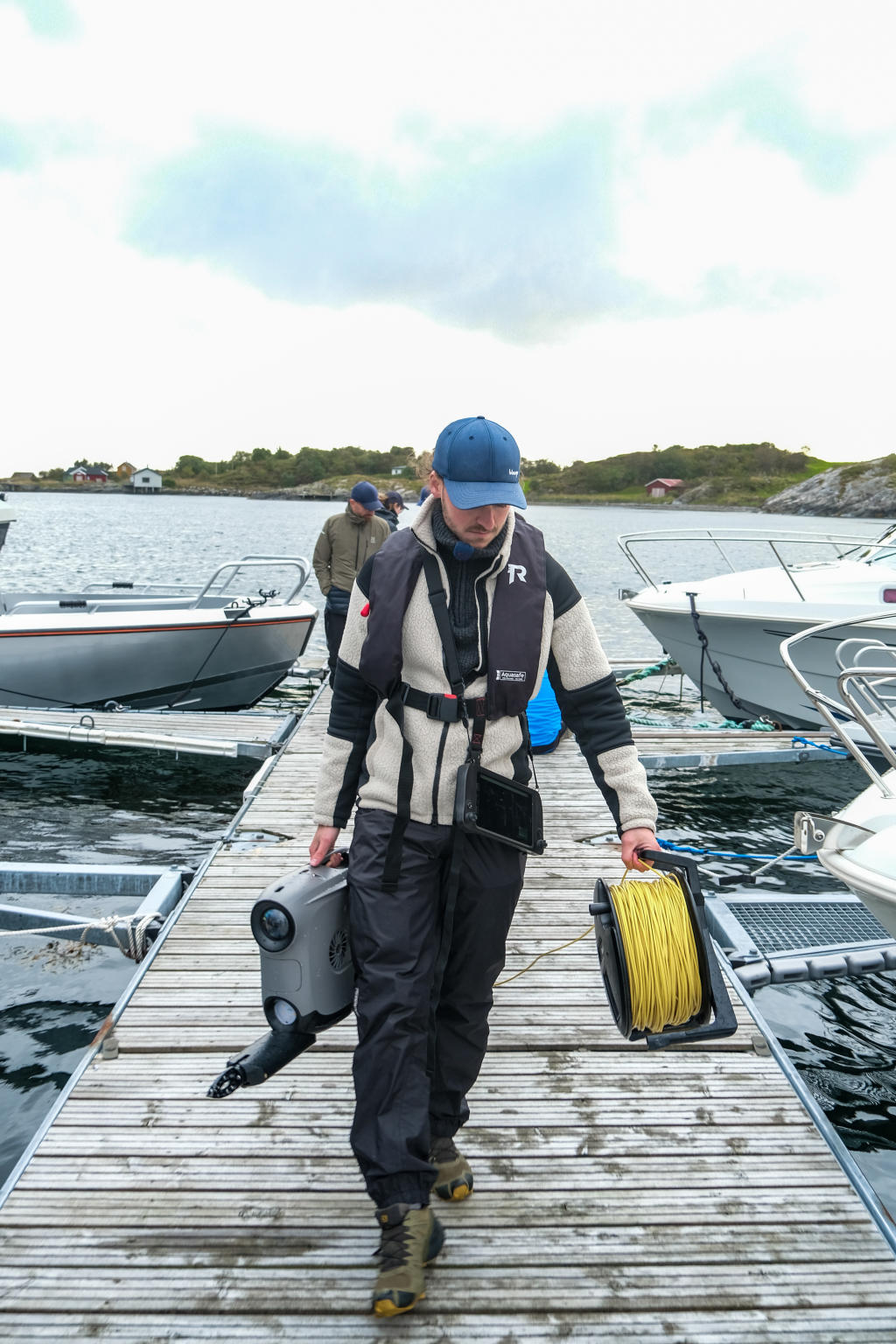
A key advantage of a mini ROV is mobility.
Many of our customers conduct underwater missions in multiple locations, often traveling alone.
The Blueye X3 ROV weighs only 9 kg, making it easy for one person to transport and deploy.
We also provide a custom-fitted Zarges aluminium case with wheels to keep the mini ROV and other equipment safe when traveling.
In addition, you don't need to be a certified ROV pilot to operate the system.
It only takes minutes to connect and deploy the small ROV, making it ideal for routine inspection and everyday operations.
Quality and reliability
We also believe that a small ROV should reduce operational complexity, so when it comes to maintenance, the Blueye mini ROVs requires only a freshwater rinse after saltwater use and battery charging. All parts prone to wear are self-serviceable and easy to replace. The robust materials and high-quality electronics ensure long-term durability in harsh marine environments. When you trust your equipment, you can focus fully on the task at hand.
Professional support when you need it
No product is guaranteed to never have issues. But if support is needed, the Blueye team is available within 24 hours. The support team consist of engineers and industry experts, many of whom have been with the company since the beginning. With an overall customer satisfaction rating of 98%, reliability extends beyond the hardware.
Very professional and immediate service got us back up and running with minimal downtime. - Blueye Customer
We have also have the Blueye Help Center, where you can find:
- Articles
- FAQs
- Video tutorials
- Illustrated guides
The goal is proactive support, empowering users to solve issues independently whenever possible.
FAQ - Mini ROVs
What is the difference between a mini ROV and an underwater drone?
The terms are often used interchangeably. Technically, a mini ROV is a tethered underwater drone that provides live video and control through a cable. Consumer underwater drones are often designed for recreation, while a professional mini ROV is built for inspection and industrial tasks.
How deep can a mini ROV go?
Depth ratings vary. The Blueye X3 mini ROV is rated to 305 meters (1000 ft), which can be extended to 500 meters with the Blueye Deep Kit. Some industrial ROVs can operate deeper, but for most inspections tasks, 300 meters is more than sufficient.
How much does a small ROV cost?
The price of a small ROV varies depending on configuration, depth rating, sensors, and accessories. A professional mini ROV typically ranges between $15,000 and $75,000, depending on configuration. But still significantly lower than large industrial ROVs.
Do you need certification to operate a mini ROV?
In most cases, no formal certification is required to operate a mini ROV. However, proper training and operational procedures are recommended.
What industries use mini ROVs?
Mini ROVs are widely used in:
- Aquaculture
- Maritime and shipping
- Offshore energy
- Infrastructure
- Research and environmental monitoring
Their versatility, mobility, and lower operational cost make them ideal for routine and rapid-response underwater inspections.


