What are underwater vehicles?
Underwater vehicles are defined as autonomous or semi-autonomous vehicles made for operation below the surface. They make underwater exploration safer, more accessible and efficient by handling environments that are demanding for divers to reach. These vehicles differ widely in how they operate, how they are controlled and what missions they are built for.
Before going into the specific types, it's useful to understand the terminology that connects them. Unmanned Underwater Vehicles (UUVs) is a broad term often mentioned when discussing underwater technology. However, UUVs are not considered a standalone vehicle category. Instead, the term is used to group together all unmanned systems operating underwater.
Within the UUV umbrella, the two types are ROVs (Remotely Operated Vehicles) and AUVs (Autonomous Underwater Vehicles). These are the vehicles most people refer to when talking about underwater technology, each of them with its own strengths, use cases and operational methods.
Although USVs (Uncrewed Surface Vehicle) operates on the surface rather than underwater, they are frequently mentioned in the same context. This because they often support, extend or work alongside ROVs and AUVs. For this reason, it's important to understand how they fit into the broader underwater vehicle ecosystem.

ROVs, AUVs and USVs: How do they work?
ROV - Remotely Operated Vehicle
ROVs consist of a tethered underwater vehicle controlled in real time by a human operator from the surface. The tether sends live video and data up to the operator and carries control signals back down to the vehicle. This direct connection allows the operator to react immediately to unexpected situations, inspect areas that need closer attention or adjust the mission as conditions changes.
Because of this live connection, ROVs are well suited for tasks that require a high level of control and instant feedback. They are commonly used for hull inspections, aquaculture operations, maintenance work, research and recovery and scientific documentations. Many ROVs can also carry interchangeable tools and sensors, such as sonars, grippers, navigation and positioning. Allowing the ROV to be adapted to the specific need of each operation.
At Blueye Robotics, the ROV systems are designed to support this way of working by emphasising portability, ease of use and quick deployment. This design approach helps lower the threshold for performing underwater inspections, enabling users to carry out real-time inspections without any larger vessels or divers. As a result, inspections can be conducted more frequently and with reduced risk to personnel, even in challenging or time-critical situations.
Blueye offers three ROV systems suited for different operational needs:
- Blueye X1 – compact and lightweight, built for quick deployment and easy one-person handling
- Blueye X3 Ultra – expanded capabilities for more demanding inspection tasks
- Blueye X7 – the most advanced system in the lineup, designed for professional operations requiring greater depth, power and payload flexibility
Best suited when:
ROVs are best suited for missions that require real-time control, live video and ability to respond immediately to changing conditions underwater.
Use cases:
- Close-up underwater inspections and maintenance (hulls, infrastructure, pipelines)
- Real-time visual documentation
- Deploying different equipment, like sensors and small tools
- Maintenance


AUV - Autonomous Underwater Vehicle
AUVs are untethered, self-guided underwater vehicle that follow pre-programmed missions and have little or no interactions with a human operator while carrying out a mission. Before the mission starts, they are given a route or task, and than they complete it independently. Because nothing connects them to the surface, AUVs can travel long distances, dive deep and move freely without needing constant supervision.
This makes AUVs especially useful for jobs where large areas needs to be covered smoothly and efficiently. For example, mapping the seabed, collecting environmental data or searching wide regions for objects or changes in terrain. They can work for many hours at a time and follow their mission plan with high accuracy, even in places where it's difficult or unsafe for humans or tethered systems to operate, such as under Artic ice.
A practical example of innovation in this field is Eelume, a Norwegian company developing a unique, snake-like AUV. These are specifically engineered to map and operate close to challenging underwater topographies. These systems demonstrate how AUV technology is being used to preform efficient, long duration missions with minimal human involvement, helping expand what is possible in underwater operations.
Best suited when:
AUVs are best suited for long-range, repeatable survey missions where wide coverage, endurance and efficiency are more important than real-time control or live video.
Use cases:
- Large-area seabed mapping and surveying
- Deep-water exploration
- Long-range missions
- Environmental monitoring


USV - Uncrewed Surface Vehicle
USVs are uncrewed surface vehicle designed to operate on the water’s surface rather than below it. They play an important part of the wider ocean-technology ecosystem, often working alongside both ROVs and AUVs to support and extend their capabilities.
A USV can help carry sensors, communication equipment, cameras and sonars. In combination, they can also function as a mobile platform for mapping, data collection or remote supervision. In many operations, they act as a communication bridge between underwater vehicles and onshore operators, helping extend range and maintain stable links during longer missions.
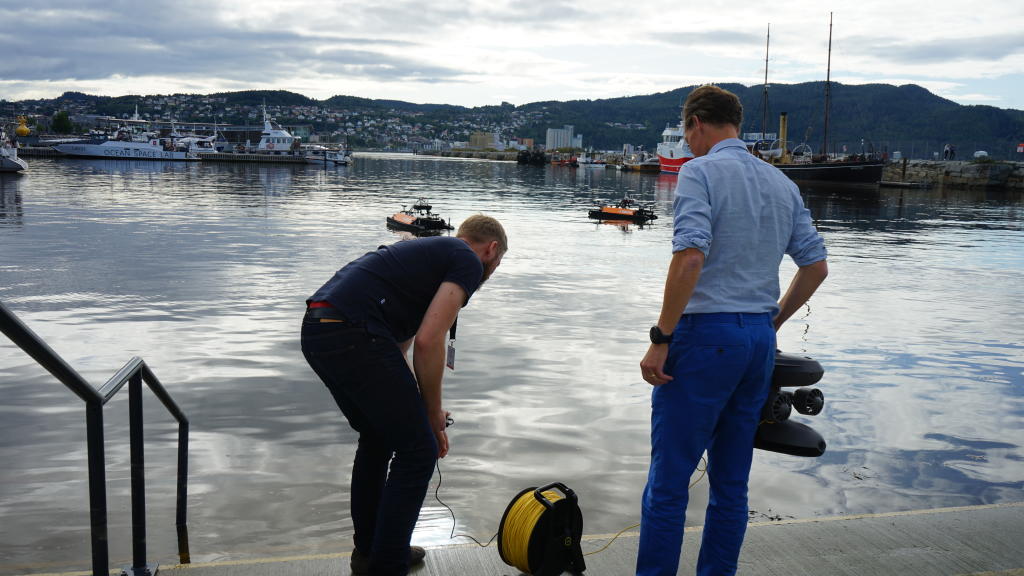
A practical example of this collaboration is the use of Maritime Robotics´ USV together with Blueye ROVs. In such setups, the USV provide surface stability, communication infrastructure and remote oversight, while the Blueye ROV preforms detailed inspections below the surface. This combination helps long-duration surface missions to be combined with precise underwater observations, creating a efficient workflow between the two systems.
Best suited when:
USVs are best suited as surface platforms that support underwater operations by carrying sensors, extending communication range or enabling long-duration missions.
Use cases:
- Carring sensors and equipments (cameras, sonars, water-quality sensors)
- Acting as a communication relay between vehicles and onshore operators
- Long-duration surface missions where continuous monitoring is needed
- Providing surface stability and support for underwater inspections

Overview of the differences Between ROVs, AUVs, USVs, and UUVs
| UUVs | ROVs | AUVs | USVs | |
|---|---|---|---|---|
| Operates where? | Both | Underwater | Underwater | Surface |
| Tethered? | Both | Yes | No | Both |
| How is it controlled? | Remote-controlled or autonomous | Human operator via tether | Fully autonomous, pre-programmed | Remote-controlled or autonomous |
| Primary use? | Umbrella term for both ROVs and AUVs | Real-time underwater inspections | Long-range mapping & surveying | Surface-level data collection & remote missions |
The Future of Underwater Vehicles
As the technology continues to advance, the vehicles are becoming more capable, more accessible and more integrated into everyday marine operations. This progress will also help shaping multiple areas of the future:
Sustainability and environmental monitoring
As environmental challenges keeps on growing, underwater vehicles will pay an increasingly central role in monitoring marine ecosystems, tracking pollution and providing vital data. Their ability to operate quickly and non-invasive makes them valuable tools in sensitive environments.
Safety and reliability
As underwater vehicles become more reliable and easy to operate, they will increasingly replace or support divers in a variety of underwater tasks, reducing human risk and improving overall safety in the workflow. Something we have explored more in depth in our article “How ROVs and divers are transforming underwater inspections for safety and efficiency".
Smaller, more affordable systems
As innovation progresses, underwater vehicles are expected to become more compact, affordable and user-friendly. This development will make advanced systems accessible to a wider range of organisations, enabling new sectors to integrate underwater technology into their operations.
A more connected ecosystem
A more integrated ecosystem between USVs, ROVs and AUVs will allow the systems to collaborate more effectively, share data and adjust missions in real time. This could improve situational awareness, reduce operational complexity and enables users to conduct underwater work more informed and efficient.
FAQ
What is the difference between a ROV and an AUV?
ROVs are tethered vehicles controlled in real time by an operator, while AUVs operate autonomously on pre programmed missions without continuous human control.
What are ROVs commonly used for?
ROVs are commonly used for underwater inspections, maintenance, documentation, and search operations where real-time control and live video are required. For a deeper explanation, see the article What are ROVs.
Can ROVs, AUVs and USVs work together?
Yes. These systems are often used together, where USVs provide surface support and communication, AUVs handle wide-area surveys and ROVs perform detailed inspections.
What does UUV mean?
UUV stands for Unmanned Underwater Vehicle and is an umbrella term that includes all unmanned systems operating underwater, such as ROVs and AUVs.
Are underwater vehicles replacing divers?
Underwater vehicles are increasingly used to support or replace divers, in certain tasks. Particularly where safety, depth, duration or environmental conditions make human intervention risky.

Choosing the Right Underwater Vehicle for Your Mission
Understanding the differences between these systems makes it easier to choose the right technology for your mission - whether the priority is autonomy, control, coverage or flexibility. Key factors include mission type, required level of control, coverage area, operating environment, duration and available infrastructure.